

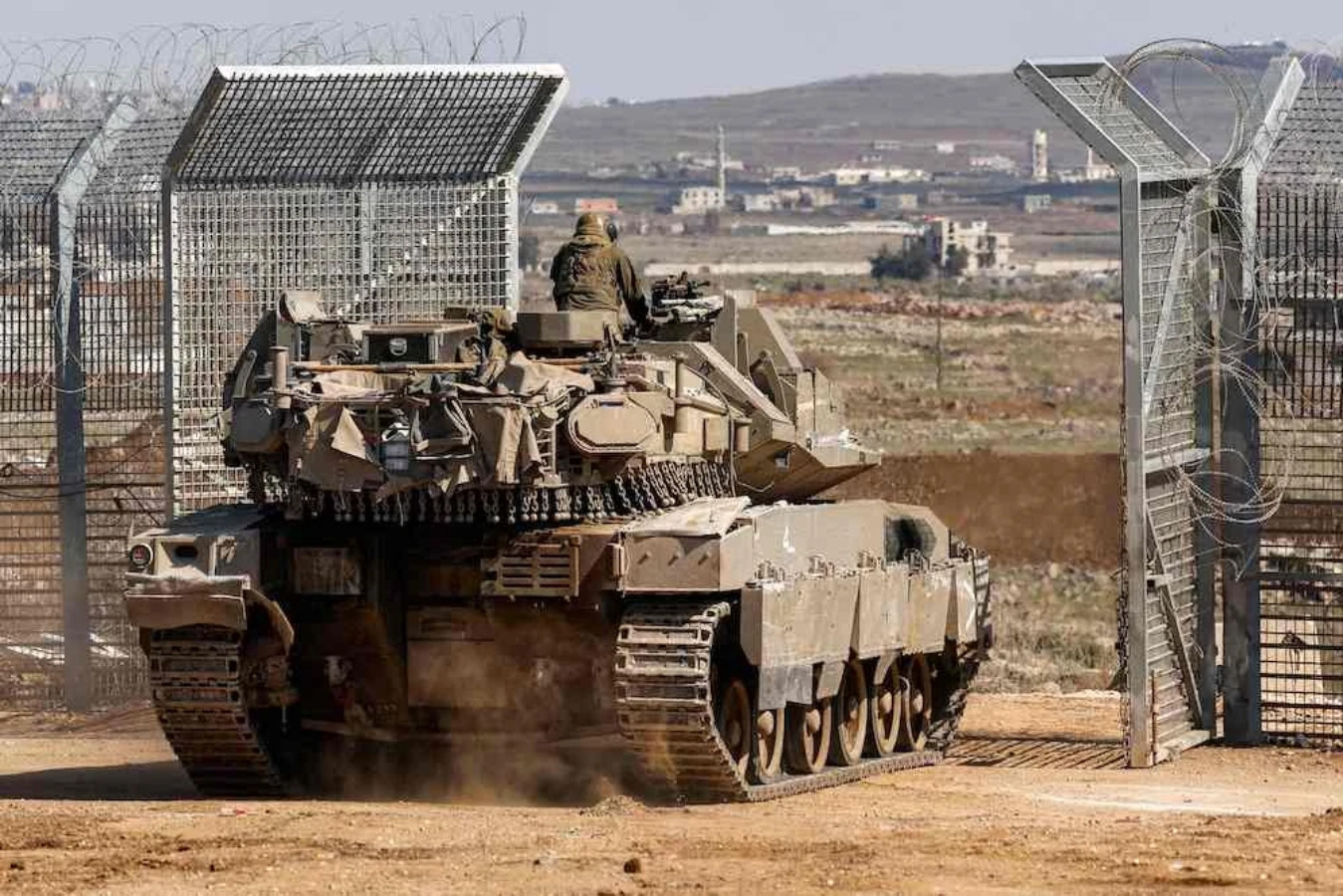
Israeli forces restarted excavation work Sunday west of Al-Asha village in Syria’s southern Quneitra as part of a project known as the “Sufa Line,” or “Sufa 53,” according to Syria Alikhbaria TV.
Military vehicles and bulldozers were seen digging near the separation line with the occupied Syrian Golan Heights, extending a route that runs through rural communities from northern to southern Quneitra.
For residents, the project has meant the loss of agricultural land, damage to grazing areas and vegetation, and changes to the natural flow of rainwater in a province where many families depend on farming and livestock.
What is Sufa 53?
Israel began work on Sufa 53 in mid-2022 near Hadr in northern Quneitra before extending it south through areas near Jubata al-Khashab, Al-Hamidiyah, Qahtaniyah, Bir Ajam and Bariqa toward Al-Asha.
The project includes a military road roughly eight meters wide, deep trenches, earth berms reaching about five meters in height, observation posts and military positions.
Read: Syria condemns Israeli excavation work near occupied Golan Heights
Israel claims that the fortifications are designed to prevent possible attacks by Iran-backed armed groups.
Construction continued after the fall of the Bashar al-Assad government in December 2024 and intensified as Israeli forces expanded their presence in and around the area of separation in southern Syria.
Syrian accounts say Israeli troops have moved between 300 and 1,000 meters into the area in some locations as work on the project expanded.
Farmland lost, livelihoods hit
The impact has been particularly severe on agricultural communities.
Local authorities previously estimated that around 12,000 dunams (1,200 hectares) of land in northern and central Quneitra had been affected by Israeli construction.
In Jubata al-Khashab alone, local officials said around 7,000 dunams (700 hectares) of land had been lost, while another 6,000 dunams (600 hectares) belonging to Al-Hamidiyah and Al-Hurriyah were taken over for the project.
Residents have also reported extensive damage to grazing land, trees and wild vegetation that had provided an important source of income for local families.
Read more: Israeli airstrikes hit Syrian airbase
Quneitra media director Mohammad al-Saeed previously told Anadolu that the project had caused widespread damage across the province, while access to affected areas remained limited.
Mohammad Mazen Maryoud, mayor of Jubata al-Khashab, said the trenches had disrupted rainwater flows and contributed to soil erosion, directly affecting farming and livestock.
Residents also say the construction has come alongside repeated Israeli raids, detentions, checkpoints and restrictions on access to agricultural land.
Syria’s Foreign Ministry on Sunday condemned the renewed work on Sufa 53, describing it as a “flagrant breach” of the 1974 disengagement agreement and a violation of international resolutions.
The ministry warned that continued Israeli incursions and military activity threatened regional security and stability and undermined international law.
Damascus reaffirmed its right to exercise sovereignty over all Syrian territory and urged the international community to uphold Syria’s territorial integrity and act against continued Israeli violations.