

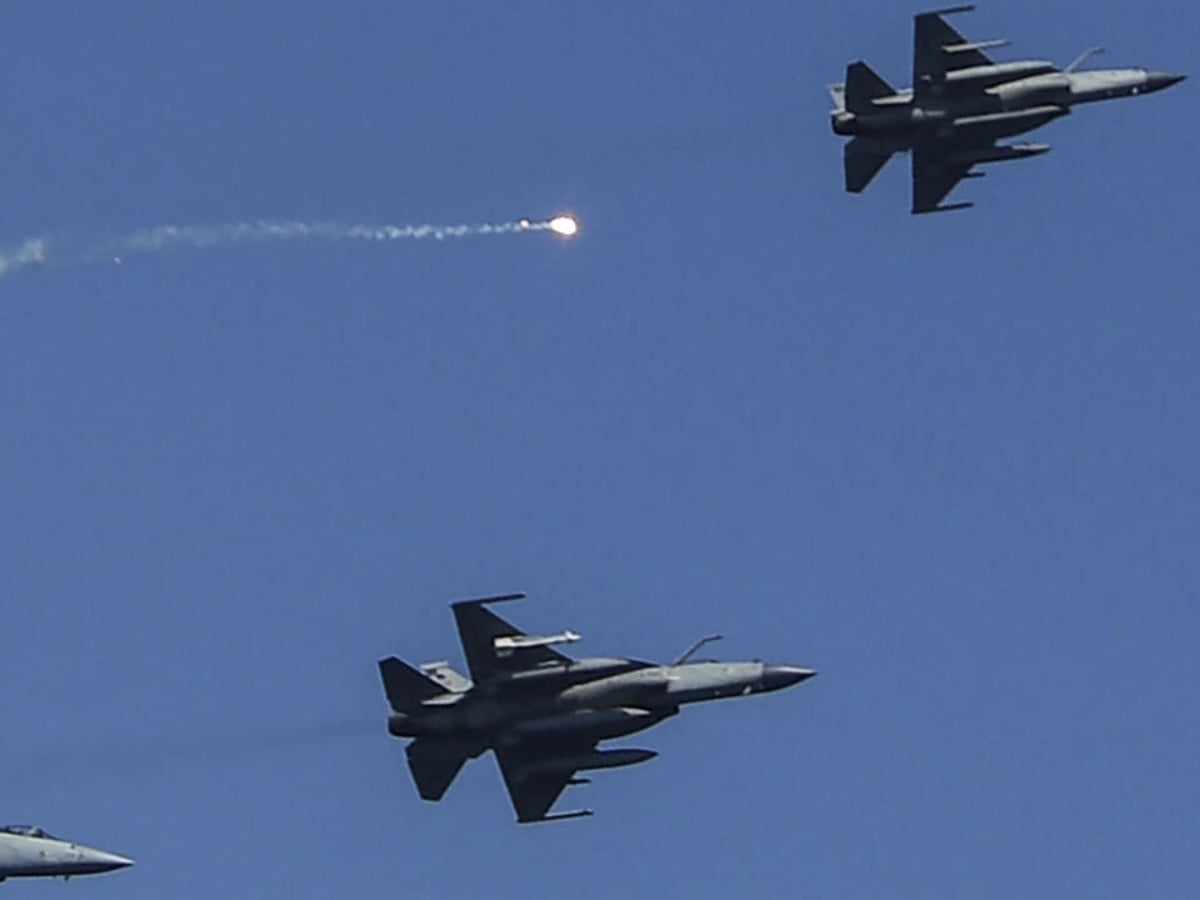
Pakistan carried out “calibrated” air strikes against terrorist hideouts near the Afghan border following a series of deadly attacks in Khyber-Pakhtunkhwa (K-P), the Ministry of Information and Broadcasting (MoIB) said on Monday.
“In the aftermath of recent multiple terrorist incidents inside Pakistan against the innocent people of K-P, a well-planned intelligence-based ground operation was carried out by security forces around Kohat, Hangu and Thal, followed by calibrated Air Strikes against the hideouts and safe havens of terrorist organisations responsible for these attacks, said MOIB in a statement.
The development emerged after 23 people, including 15 police personnel, were martyred in the blast at a mosque in Kohat’s Police Lines during Friday prayers. During the search and clearance operation, eight terrorists were also killed. Ittihadul Mujahideen Pakistan (IMP), led by Afghanistan-based Hafiz Gul Bahadur, has claimed responsibility for the deadly bombing and rampage involving multiple attackers.
The ministry said that on September 20, security forces conducted an intelligence-based ground operation against a group of terrorists in Kohat and Hangu districts. “As a result of precise and skilful engagement, nine khwarij belonging to the Indian proxy Fitna al-Khawarij were sent to hell, while several were injured.”
“Moreover, based on credible intelligence, selective targeting of terrorist camps and hideouts belonging to Fitna al-khwarij and its affiliates has also been carried out in the border region with Afghanistan with precision and accuracy. Three targets were destroyed with precision, including a suicide bombers’ training markaz, killing twenty-eight terrorists alongside multiple suicide bombers. Large quantities of weapons and ammunition stored at these Marakiz and hideouts were also destroyed,” it added.
In the aftermath of recent multiple terrorist incidents inside Pakistan against the innocent people of Khyber Pakthunkhwa, a well planned intelligence based ground operation was carried out by security forces around Kohat, Hangu and Thal, followed by calibrated Air Strikes…
— Ministry of Information & Broadcasting (@MoIB_Official) September 21, 2026
The statement said Pakistan had always strived to maintain peace and stability in the region, but the safety and security of its citizens remained its foremost priority.
“It is a matter of grave concern that Afghanistan continues to remain a hub of terrorism. The threat to Pakistan emanates from Afghanistan. In this context, our action precisely targeted the terrorist hubs. Maximum precautions were taken, and it was ensured that no collateral damage occurred,” the MoIB said.
The ministry further stated that the counterterrorism campaign, Ghazab lil Haq, being carried out by Pakistan’s security forces and law enforcement agencies under the “Azm-e-Istehkam” framework, would continue at full pace to eliminate what it described as the menace of foreign-sponsored and supported terrorism from the country.
Read: No change in Pakistan’s Afghan policy
The strikes were carried out as two officers among six security personnel were martyred yesterday in an exchange of fire between a security forces convoy and terrorists in K-P’s Hangu district. Eight terrorists belonging to the Fitna al-Khawarij were killed during the exchange.
In response to continued attacks across the province, Pakistan’s Permanent Representative to the United Nations, Ambassador Asim Iftikhar Ahmad, warned that Islamabad would respond in self-defence to terrorism emanating from Afghanistan “as and when needed.”
The Pakistani envoy, while addressing the UN Security Council, stated that Islamabad would not sit idle in the face of this terrorist onslaught, saying that Pakistan had made sustained efforts to alleviate the suffering of Afghans despite reservations over certain policies of the Taliban.
“Afghanistan has once again become a safe haven for numerous terrorist groups operating with impunity from its soil,” Ahmad had said, linking Pakistan’s security concerns to what he described as ties between the Taliban and terrorist groups, including the Tehreek-e-Taliban Pakistan (TTP). “Over the last three years alone, more than 4,700 innocent Pakistanis have lost their lives to terrorism emanating from Afghanistan,” the envoy had said.
Read More: Five years of Taliban rule defined by failures, broken promises, security risks: report
In a separate warning following the terrorist attack in Kohat, Pakistan said it had the “will and capability” to eliminate terror threats “wherever they are” and urged the international community to press the Afghan Taliban regime to take decisive action against terrorism.
Attributing the attack to “the vilest of Khwarij with roots in Afghanistan” the Pakistan’s Information Ministry noted that the attack was a reminder that “terrorism has no religion and no justification”. It added that Islamabad had repeatedly raised “grave concerns” over the alleged use of Afghan territory by the banned TTP and other terrorist groups to plan and launch attacks inside the country.
“The presence of terrorist sanctuaries, alongside their recruitment and support infrastructure in Afghanistan, poses a direct threat to Pakistan’s security,” the ministry had said. It added that these concerns had repeatedly been conveyed to the Afghan Taliban regime and its interlocutors. “They must dismantle these networks rather than deflect responsibility,” Pakistan said.
Earlier, a United Nations Security Council report formally implicated the banned Balochistan Liberation Army (BLA) and terrorist entities operating from Afghanistan, highlighting tactical collaboration and shared operational logistics between the groups.
Member-state reporting confirmed that BLA militants were trained alongside TTP members at facilities in Afghanistan, according to the report, which also described growing operational links among various militant groups operating across the border.
This was not the first time a UN report pointed to the threat posed by militant groups operating from Afghanistan. In 2023, a UN report also revealed that the TTP had established a new base in K-P in mid-2023, shedding light on close ties between the TTP and the Afghan Taliban, as well as between the TTP and anti-Pakistani groups and Al Qaeda.