

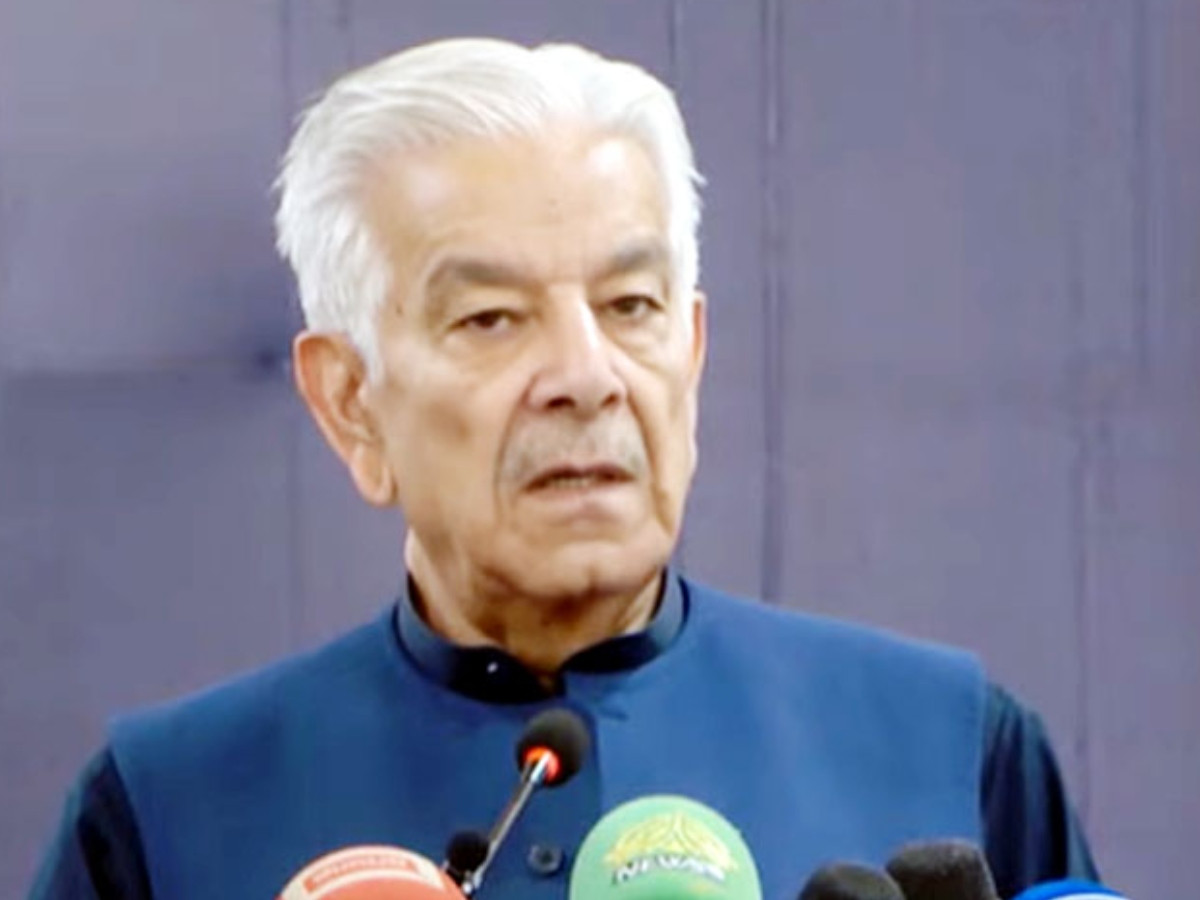
Defence Minister Khawaja Asif said on Saturday that Pakistan’s victory in Marka-e-Haq enhanced the country’s international standing, Radio Pakistan reported.
The term Marka-e-Haq refers to the 2025 conflict with India, which began after India falsely blamed Pakistan for the April 22 Pahalgam attack and concluded with a ceasefire on May 10 following a successful Operation Bunyanun Marsoos launched by the country’s armed forces.
Addressing the annual convocation of the University of Central Punjab in Sialkot, the minister said Pakistan had defeated an enemy five times larger than itself, adding that the Pakistan Armed Forces had shot down several enemy aircraft.
“Pakistan’s success has also been acknowledged by international media,” he stated during the speech.
Read: Military notes of Indo-Pak conflict: inferences and conclusions
He said the Pakistan Armed Forces had been fighting terrorism for several decades while continuing to fulfil their responsibility of safeguarding the country’s borders.
The defence minister described the youth as the country’s most valuable asset, emphasising that educated and skilled young people could play a vital role in national development and prosperity.
The 2025 Indo-Pak war
The tensions between the nuclear-armed neighbours, Pakistan and India, escalated following the April 22 attack in Pahalgam, located in the Indian Illegally Occupied Jammu and Kashmir (IIOJK), which claimed 26 lives. India accused Pakistan of involvement without evidence, while Islamabad categorically rejected the claims.
Defence Minister @KhawajaMAsif says Pakistan’s victory in Marka-e-Haq has enhanced the country’s prestige@OfficialDGISPR #RadioPakistan #news https://t.co/iebXcxRpAB pic.twitter.com/NhSbgmrVbR
— Radio Pakistan (@RadioPakistan) October 31, 2026
A day later, on April 23, India announced the closure of the Wagah border crossing, revocation of Pakistani visas and suspension of the Indus Waters Treaty. Pakistan condemned these measures as an act of aggression and announced reciprocal steps, warning that any further escalation would bear serious consequences.
The confrontation intensified on the night of May 6–7, when India launched military strikes against Pakistan, triggering the most serious military escalation between the two nuclear-armed neighbours in decades.
Pakistan’s military response resulted in the downing of at least five Indian fighter jets, including three Rafale, one SU-30 and one MiG-29.
On May 7, Pakistan intercepted and destroyed 78 armed drones, identified as Israeli-origin Heron and Harop variants, deployed during the confrontation. An Indian missile projectile was also reportedly intercepted near Dinga, Punjab.
During the subsequent nights of May 8–9, Pakistan’s air defence systems intercepted multiple BrahMos supersonic missiles. Pakistan further maintained that its retaliatory operations targeted 26 Indian military installations in response to attacks on seven Pakistani locations, while military sources reported the destruction of several Indian brigade and battalion headquarters along the Line of Control (LoC).
The deployment of indigenous Fateh-1 and Fateh-2 missiles was also presented as a significant demonstration of Pakistan’s operational and defence capabilities.