

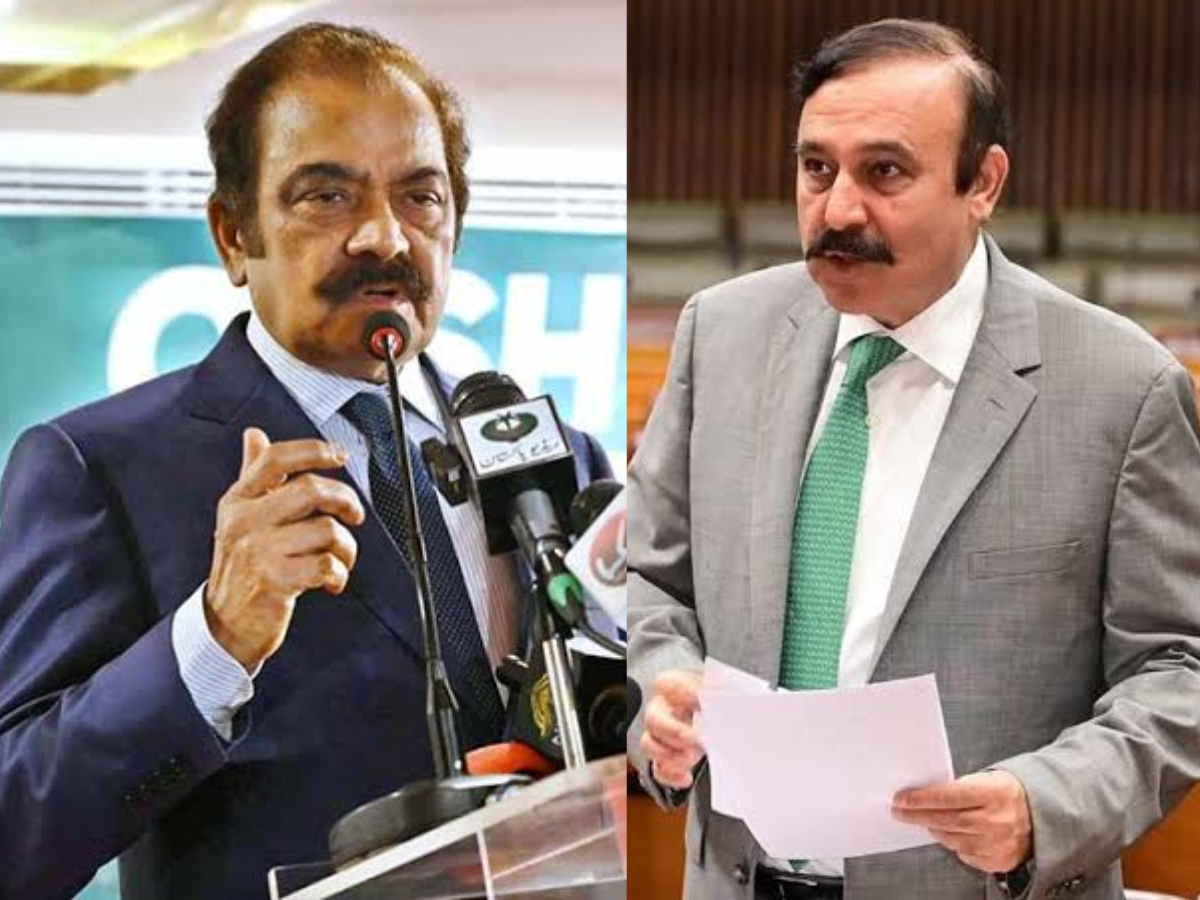
The government on Tuesday urged all political parties to set aside their differences and forge a consensus on a joint strategy to combat terrorism, saying it was a national issue that required collective efforts and a unified response.
“This is a national issue. We can sit together and formulate a policy. When everyone puts their heads together, a decision can be made, as happened when Zarb-e-Azb was launched. Even now, if all political parties [..] sit together and discuss this issue, I am making an offer today: if all parties come together and reach an agreement on this issue, the prime minister is still willing to invite them to resolve it. He is ready to proceed with these operations with everyone’s support,” said Special Adviser to the Prime Minister Rana Sanaullah while speaking in the Senate.
Sanaullah said terrorism was a national issue that required all political parties to set aside their differences and agree on a joint strategy, adding that the government was prepared to engage with the opposition to resolve the matter.
He urged Jamiat Ulema-e-Islam-Fazl leader Maulana Abdul Wasey to speak to party chief Maulana Fazlur Rehman.
Comparing the provincial governments’ approaches to counterterrorism, Sanaullah accused the K-P government of failing to provide the cooperation needed to eliminate terrorism, while saying the Balochistan government was fully cooperating with the armed forces and the federal government.
He said the now non-functional Khyber-Pakhtunkhwa (K-P) chief minister Sohail Afridi had repeatedly stated that he would not allow operations in the province, adding that provincial apex committees provided a forum for discussing security matters, with the core commander attending meetings under the respective chief ministers’ leadership.
Sanaullah said he had attended apex committee meetings in Balochistan alongside the prime minister, where issues were discussed openly. In contrast, he said, only one meeting had taken place in K-P in 11 months, “and in that meeting the way that the CM was taken there Mohsin Naqvi described those circumstances.”
“If you only raise the issue of terrorism to create headlines, I do not think that is national service or the right approach to resolving the problem,” he said.
Read: PHC seeks Centre’s response over imposition of emergency, governor’s rule in K-P
Sanaullah also criticised National Assembly opposition leader Raja Nasir Abbas for refusing to meet the prime minister or visit the speaker’s chamber, despite accepting the position of opposition leader.
Recalling an encounter with Abbas during a joint sitting of parliament, Sanaullah said, “I told him to leave this stubbornness aside and set a time to meet the prime minister,” adding that Abbas had refused, saying he did not recognise the National Assembly speaker.
Sanaullah questioned how Abbas could accept the position and its associated privileges while refusing to engage with the government through parliamentary channels.
The adviser also recalled negotiations with Pakistan Tehreek-e-Insaf (PTI) over elections after the party dissolved its provincial assemblies. He said both sides had agreed to hold general elections in the first week of September, but the agreement subsequently fell through.
Sanaullah said PTI leader Shah Mahmood Qureshi had asked for time to inform the party’s founding chairman, Imran Khan, that the negotiating committees had reached an understanding. However, he said the party later rejected the agreement.
He added that a draft of the negotiations was available to the media and that committee members, including Sohail Afridi, had exchanged messages about the discussions.
Referring to recent negotiations, Sanaullah said several matters, including arrangements for meetings and other outstanding issues, had been settled. The parties had also discussed forming a political committee comprising representatives from both sides to address unresolved matters.
However, he said, the opposition had refused to sign the draft over one point: supporting counterterrorism operations and fulfilling its responsibilities in the fight against terrorism.
Sanaullah also responded to remarks by PTI leader Mashal Yousafzai about a helicopter and an alleged message conveyed during negotiations. He said the opposition had claimed it was asked to sign an agreement under which an emergency would be imposed within 72 hours and to call off its long march unconditionally.
Read more: ‘No link between K-P emergency, minerals’
“If this was your preparation, as has now come to light, then I consider this another missed opportunity,” he said.
Sanaullah said security personnel continued to be killed in the fight against terrorism, paying tribute to an army major who was martyred yesterday in an IED attack. He criticised what he said was a narrative targeting an entire institution and its head, accusing some political actors of making derogatory remarks and amplifying them through social media.
Sanaullah said the government could restrict meetings with Imran under the law if party leaders continued to make derogatory remarks about the head of a state institution. “Then, under the rules and the law, restrictions can be imposed on meetings,” he said.
Sanaullah also questioned PTI’s repeated attempts to secure political gains through different channels, including the courts and US President Donald Trump, rather than resolving its disputes through negotiations.
He said the recent long march was PTI’s third such attempt and recalled earlier marches towards Islamabad, adding that it was PTI leaders, rather than the government, who had spoken about bringing two million people to the capital and launching an attack.
He urged the opposition to reconsider its approach and resolve its outstanding issues through dialogue, reiterating that the fight against terrorism required collective national support.
Chaudhry urges unity on terrorism
Later in the day, Chaudhry, in a press conference, urged, “Let us begin with this single issue and this single-point agenda — that we have to develop a consensus against terrorism,” Chaudhry said, inviting opposition parties to sit with the government and agree on a joint policy.
“Two opposition leaders were with me at a programme yesterday, and they said that all political parties should develop a consensus against terrorism. I extended the invitation yesterday, and I am extending it again today to all opposition parties — and our allies are already with us — to come and sit together so that we can develop a consensus against terrorism,” the minister said.
He urged all political parties to reach a consensus against terrorism, saying it was an issue on which “we should all be united” and that Pakistan’s peace and the future of its children were at stake.
Chaudhry said political differences should not come at the expense of national interests, asking why parties could not reach a consensus on issues concerning Pakistan’s development, prosperity and peace.
“Politics is not meant to compromise the national interest,” he said, reiterating his invitation to opposition parties to work together against terrorism.
Taking aim at the PTI’s performance in K-P, Chaudhry questioned why the party had failed to establish peace despite being in power in the province for 10 to 12 years, including its more recent two-and-a-half-year tenure.
“On one side, bombs are exploding, and the bodies of our martyred soldiers, officers, police personnel and Frontier Corps personnel are being sent to their homes. On the other, you have created a strange spectacle on the streets, as if it were an Under-19 tournament,” he said.
“Neither does the province function this way, nor does the country,” he added, urging the PTI to work with the federal government and contribute to ongoing intelligence-based operations.
“Even today, if you come to your senses and sit with the federal government, your own leaders are speaking. Develop a consensus on this issue,” he said, adding that the government remained committed to the fight against terrorism.
Chaudhry also defended the imposition of emergency in K-P, saying the federal government had taken the step in response to security challenges rather than out of a desire to assume control of the province.
He said an advisory council had been formed comprising technocrats with expertise in their respective fields, while a separate council included tribal elders to ensure local communities were consulted on intelligence-based operations.
“The federal government and the armed forces are committed to continuing operations against terrorists until terrorism is completely eliminated,” he said.
Distinguishing K-P and Balochistan, Chaudhry said the provincial administration and chief minister in Balochistan were cooperating with the federal government and law enforcement agencies in the fight against terrorism.
“The chief minister is standing shoulder to shoulder with our law enforcement agencies and is on the front line in confronting terrorists,” he said, adding that the Balochistan government was not refusing to cooperate with counterterrorism operations.
The minister also criticised those linking the imposition of emergency to the province’s mineral resources, arguing that Pakistan needed to utilise its natural wealth to generate resources for development and reduce its debt burden.
“If Allah has blessed Pakistan with these treasures, which have remained buried for 80 years, and you want to keep them buried for another 80 or 180 years, that is your choice,” he said.
He maintained that the people of the province where minerals were located would have the first right to those resources. He added that international companies involved in exploration would be expected to follow international standards and ensure their activities did not create difficulties for local communities.
Resources generated through minerals, oil and gas, he said, could help fund improvements in education and healthcare across the country.
He said the federal government’s two primary objectives were to establish lasting peace and completely eliminate terrorism, adding that emergency would remain in place until those targets were achieved.
“We can compromise on politics, but we cannot compromise on the state, the interests of the state or state institutions,” he said.
Calls for dialogue
The government and opposition made several attempts to reach a political understanding before emergency and governor’s rule were imposed in K-P. PPP Chairman Bilawal Bhutto-Zardari urged the federal government to pursue dialogue before resorting to constitutional measures, saying political parties needed to work together against terrorism. He later offered to approach Prime Minister Shehbaz Sharif to end the emergency if the opposition agreed to political dialogue.
Talks between the government and opposition subsequently broke down amid disagreements over access to PTI founder Imran Khan and the provincial government’s role in counterterrorism. The government said the parties had agreed on most points but could not reach consensus on support for counterterrorism operations. PTI, however, blamed the government’s refusal to meet its demands, particularly access to Khan, for the deadlock.
After negotiations failed, the federal government imposed emergency and governor’s rule in K-P on October 11, citing the deteriorating security situation and what it said was a lack of cooperation from the provincial administration in the fight against terrorism. Prime Minister Shehbaz Sharif said the government had been left with no option but to take the measures after efforts to reach an agreement failed. The move brought the PTI-led provincial administration to an end and prompted legal challenges.
The deterioration in security has intensified pressure for a coordinated response. According to a Centre for Research and Security Studies report, violence-linked fatalities rose by 83 per cent in the third quarter of 2026, with 1,415 deaths recorded across 385 incidents. Balochistan accounted for most of the increase, while K-P remained a major hotspot for attacks.
In K-P, terrorist incidents increased by 195 per cent between March 2024 and September 2026, according to security reports presented to the federal cabinet. The reports also flagged a sharp rise in drone attacks and shortages of modern weapons, operational equipment, and trained personnel in the provincial police and Counter-Terrorism Department.