

Amid fraying ties with the United States, Canada’s push to move closer to Europe is taking shape around a new idea: an “associate member” relationship with the European Union that would stop short of full membership but deepen ties across trade, defence and technology.
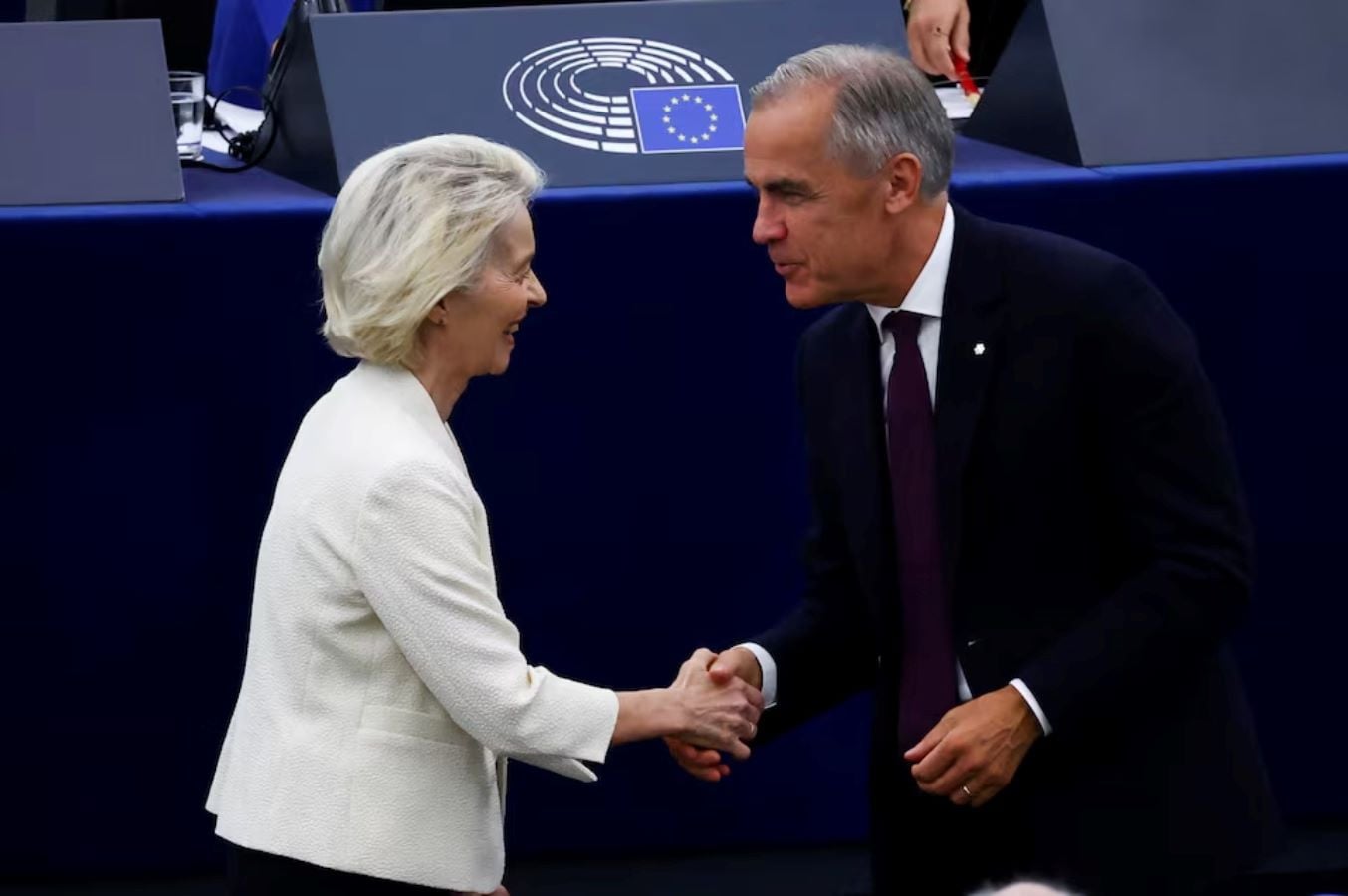
European Commission President Ursula von der Leyen put the idea on the table Wednesday, telling Canadian Prime Minister Mark Carney that she wanted to work with him on “opening the door on Canada being the first associate member of the EU.”
The proposal, made at the European Parliament in Strasbourg, would break new ground.
The EU currently has no formal category of “associate membership,” meaning its precise legal structure, rights and obligations would have to be worked out.
Carney embraced the broader ambition Thursday in his own address to European lawmakers, calling for what he described as an “alliance for the future” spanning critical minerals, defence, artificial intelligence, energy, research, financial services and digital trade.
What is being proposed?
Neither side is proposing that Canada become the EU’s next full member. Carney said after his speech that Ottawa is neither in a position nor seeking to become a full EU member, stressing that the substance of the relationship would matter more than whatever label is ultimately attached to it.
Instead, von der Leyen has proposed building on the Canada-EU Comprehensive Economic and Trade Agreement (CETA) to create what she called a “common prosperity and economic security space.”
CETA has been provisionally applied since September 2017, eliminating tariffs on the vast majority of goods traded between the two sides. But it has still not fully entered into force because 10 EU member states have yet to complete national ratification.
Read: Canada applies to join UK-led military coalition
Carney’s proposals suggest the new relationship could go considerably further. He called for Canada and Europe to work together on critical mineral supply chains, defence industrial capacity, artificial intelligence and computing infrastructure, energy security, space and payment systems.
He also proposed moving toward “seamless, digital trade” in non-agricultural goods and a wide range of services, while also exploring a more integrated market for financial services. Carney also said Canada could participate in the EU’s Erasmus+ student exchange program and the next generation of its Horizon research program, arguing that young Canadians and Europeans should have greater opportunities to live, work and study on either side of the Atlantic.
Canada has already moved closer to the EU in defence, becoming the first non-European country to participate in the bloc’s SAFE defence procurement initiative.
Why now?
The push comes as Canada seeks to reduce its heavy economic dependence on the US amid a sharp deterioration in relations with Washington.
The US accounted for 71.7% of Canadian merchandise exports in 2025, according to Statistics Canada, leaving Ottawa particularly exposed to changes in American trade policy.
Washington and Ottawa are now engaged in an escalating tariff dispute, with each side imposing 50% duties on roughly $20 billion worth of selected goods. President Donald Trump has also repeatedly suggested Canada should become the 51st US state, an idea Carney and most Canadians vehemently reject.
Without naming the US in his European Parliament speech, Carney said economic integration was increasingly being used as a weapon, tariffs as leverage and supply chains as vulnerabilities that could be exploited.
He argued that sovereignty now requires countries to have secure access not only to food, energy and defence but also to artificial intelligence, semiconductors, critical minerals, payment systems, clean-energy technology, vaccines and space-based communications. “The objective is not self-sufficiency. It is collective resilience,” he said.
Carney also sought to distinguish the proposal from an attempt to create another geopolitical power centre. “I am not proposing a third bloc in order to become a great-power rival — only with better manners,” he said, adding that the objective was to build enough resilience to prevent other powers from controlling open markets or dictating national choices.
How has Washington responded?
Trump has directly warned against the emerging arrangement. Speaking in North Carolina on Wednesday, he said the EU’s effort to bring Canada closer could be considered a “hostile act” if it was undertaken with what he described as bad intentions.
“If it’s a good intention, that’s fine,” Trump said. He warned, however, that the US could impose heavy tariffs on Europe or restrict trade in certain sectors if he concluded otherwise.
Read More: As Iran war grinds on, Trump to face skeptical world leaders at UN
Carney responded Thursday that Canada would decide for itself which international partnerships to pursue. “Nobody is going to dictate our culture, or with whom we can strike agreements,” he told reporters in Strasbourg.
The European Commission has also rejected the suggestion that the initiative is aimed at Washington, saying closer Canada-EU ties are intended to strengthen the two partners rather than target another country.
Republican Senator Susan Collins has separately cautioned that Canada’s move toward Europe could make it harder to repair its relationship with Washington and resolve the tariff dispute, while Democratic Senator Chris Coons has said he is seeking to organise a bipartisan congressional visit to Canada.
What comes next?
For now, “associate membership” remains a political proposal rather than a defined EU status.
Carney said Canada welcomed von der Leyen’s ambition but stopped short of endorsing a particular institutional model, saying the two sides would define the relationship together. Some EU diplomats have also expressed reservations about creating a new membership category, even as there is broad interest in expanding cooperation with Canada.
The next major milestone is the Canada-EU summit scheduled for October 29-30 in Montreal, where officials are expected to develop the proposed relationship further.
The eventual arrangement could therefore look less like conventional EU membership and more like a customised framework tying Canada more closely to European markets, defence programs, research networks and strategic industries.
Exactly how far that integration would go — and what either side would have to give up or change in return — remains to be negotiated.