
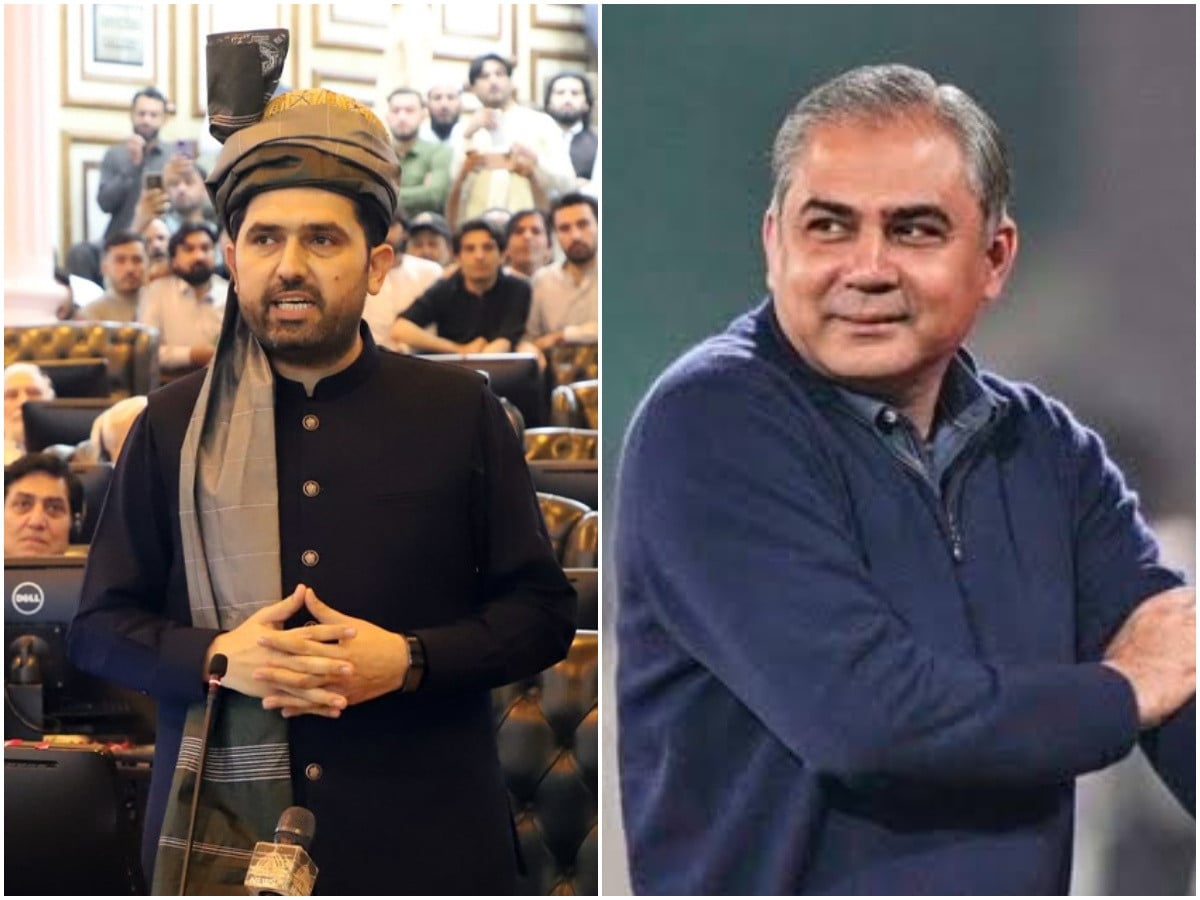
Interior Minister Mohsin Naqvi on Sunday accused the Khyber-Pakhtunkhwa government, particularly Chief Minister Sohail Afridi, of sabotaging government-opposition negotiations, saying the two sides had reached agreement on 99 per cent of the draft before the process ran into a deadlock over terrorism-related matters.
Naqvi’s remarks came after hours of talks between the government and opposition ended without an agreement, despite reports a day earlier that both sides had reached consensus on a draft ahead of the PTI’s scheduled long march.
Addressing a press conference in Lahore, Naqvi praised members of the opposition negotiating team for what he described as their efforts to settle, but said the process was repeatedly disrupted by the K-P government.
“I would like to thank them. They negotiated in a very good manner,” he said, referring to Allama Nasir Abbas, Asad Qaiser, Barrister Gohar, Salman Akram Raja, Aamir Dogar and other members of the opposition team.
“They negotiated in a way that anyone would do to reach a resolution. They should be given this credit.”
However, he said the opposition team’s efforts were undermined by its party leadership and “especially its CM”.
“Unfortunately, their party and especially their CM tried to sabotage all the negotiations,” Naqvi said.
He said the opposition negotiators had been told that they had the mandate to take decisions on behalf of their side.
“When they took the decision and finalised the draft, all of a sudden, they popped up and said that they do not agree to this,” he said.
Naqvi said there had been differences on some issues but the two sides had agreed on 99 per cent of the draft.
“There were some issues in the wording and other things. All the issues were resolved one by one,” he said.
He said the draft was finalised and subsequently changed four times during 12 hours of negotiations.
“We used to finalise one thing and then change it,” he said, adding that the negotiating teams had made repeated efforts to resolve differences.
“If Sohail Afridi had to make a decision, he would have come to the negotiations himself,” Naqvi said.
He said he had spoken to Barrister Gohar two days earlier and requested that either Afridi or one of his representatives attend the talks because it was important for the K-P government to have a representative in the negotiations.
Naqvi said the government did not have a political dispute with the opposition during the talks and that the main issue was counterterrorism.
“Our issue is entirely terrorism-related,” he said.
He said the government wanted the K-P government to join the federal government in efforts against terrorism, while political matters could be addressed separately through dialogue.
Naqvi said he had asked the opposition to bring the K-P government on board because “the issues that we are facing are coming from the K-P government”.
He said Qaiser had agreed to speak to the provincial government and asked that the meeting be postponed until the following day.
The negotiating team subsequently held four hours of talks with the K-P chief minister, Naqvi said, adding that Afridi gave his feedback and authorised the team to proceed with whatever was finalised.
Naqvi said two agreements were under discussion — one concerning the political issues and another relating to terrorism.
The latter included matters related to the Police Act, kidnappings, the Tehreek-i-Taliban Pakistan, former Fata and the National Action Plan, he said.
“We told them that what we are discussing with you is very important. It should be on record,” he said.
Naqvi said the government had not initially asked the opposition to postpone its planned long march.
“When the first meeting took place, I told them that we do not have a problem with a long march,” he said.
However, he said the PPP had sought postponement of the march after party Chairman Bilawal Bhutto-Zardari called for the political temperature to be lowered.
Naqvi said the PPP had told the opposition that it would settle the outstanding issues if the long march was postponed.
“So they said, okay, if we settle these things, we will do a long march,” he said, adding that the negotiations had therefore started positively.
Naqvi said the talks might not have been conducted in the same manner had the government known that there was no authorised person in the committee with the backing of the K-P government, or that the provincial government would veto the agreements reached by the negotiators.
“We did it with a very good policy,” he said.
The minister said the two sides had agreed completely on political issues and the statement was issue, while concessions offered by the government were intended to bring the K-P government on board in the fight against terrorism.
“We were telling them that in this terrorism that is happening in your province, you and I are standing together,” he said.
Naqvi said it was not appropriate for a province to be at war while ministers issued statements against the army or did not attend soldiers’ funerals while also claiming that that terrorists were receiving support at the local level.
“So in no way can there be a war like this,” he said.
He said the government’s request was for the K-P government to join the fight against terrorism, while political issues could be discussed separately.
“But at this time, the most important thing is that for the country, for the terrorism that is spreading the most in your province, to stop that, we will work together,” he said.
Naqvi rejected the notion that political negotiations could extend to decisions about military operations.
“If we have to do politics in that, and if we have to say that in the operation of the army, I will tell you which gun to use, which bullet to use and which drone to use, then that is not happening anywhere in the world,” he said.
Naqvi said long marches and such calls were harmful for the country, citing disruption to the stock exchange, difficulties for local residents and road closures.
“No government would want people to have such a problem,” he said.
He also warned that if the long march resulted in a loss of life, CM Afridi would be held responsible.
“If even one person dies, Sohail Afridi will be responsible,” Naqvi said.
PTI urges govt to address deadlock, show willingness for talks
Later, Pakistan Tehreek-i-Insaf (PTI) expressed regret over the failure of negotiations between its joint team with Tehreek-e-Tahafuz-e-Ain Pakistan (TTAP) and government representatives, urging the government to address the reasons for the deadlock and demonstrate its willingness to engage in meaningful dialogue.
In a statement on X, the party said the negotiations concluded without substantive progress despite “serious efforts” to address political stability, restoration of democracy, supremacy of the Constitution and law, access to PTI Founder Imran Khan, his health and medical treatment, and the worsening security situation in K-P and other parts of the country.
PTI said the principal point of deadlock was its demand for immediate access to Khan so that the party leadership could consult him on matters of national and political importance.
PRESS RELEASE
PTI Responds to Inconclusive Negotiations and Federal Ministers’ Press Conference
Party Says Denial of Access to Chairman Imran Khan Remained Central Impediment; Calls for Consensus Based Counterterrorism Strategy and Immediate Attention to Khan’s Medical Care…
— PTI (@PTIofficial) October 4, 2026
It said its negotiating team had conveyed that other demands could be set aside if the government agreed to this single request. However, according to the party, the government declined to make access to Khan part of the proposed agreement.
The party maintained that consultation with political leadership was an essential part of the democratic process, arguing that just as leaders of other political parties remained central to their parties’ policy and decision-making, PTI should also be able to consult its chairman on major political and national issues.
“Restricting such consultation, particularly during a critical period for the country, inevitably limits the scope for meaningful political engagement,” it said.
PTI said the situation in K-P was another major issue discussed during the negotiations.
According to the party, the government side sought the provincial government’s unconditional support for counterterrorism measures and operations undertaken by the federation and relevant authorities, as well as support for emergency measures within 72 hours in the merged districts and adjoining areas.
PTI reiterated its “unequivocal condemnation” of terrorism and stressed that eliminating terrorism, protecting citizens and restoring lasting peace must remain a national priority.
The party paid tribute to officers and personnel of the armed forces, police, security forces and other law-enforcement agencies who had sacrificed their lives in the fight against terrorism, while expressing solidarity with civilians and families affected by terrorist violence.
It said the people of the province had paid an “extraordinary price” over the years through loss of life, destruction of property and businesses, prolonged insecurity and displacement.
“Their concerns and experiences must therefore remain central to any future counterterrorism policy,” PTI said.
The party maintained that terrorism could not be defeated through force alone or through unilateral measures that could expose civilians to further loss of life, property damage or displacement.
“Past experience must inform future policy,” it said, adding that any effective strategy must combine firm action against terrorism with protection of civilian populations and sensitivity to local realities.
PTI proposed that authorised representatives of the federal and K-P governments meet within 72 hours to develop a “clear, comprehensive and mutually agreed strategy” for peace and counterterrorism.
It further proposed consultations with political parties represented in the K-P Assembly, elected representatives, tribal elders and other relevant stakeholders so that any policy could enjoy public confidence and be implemented effectively.
The party also rejected attempts to characterise the position of CM Afridi as political obstinacy, arguing that had access to Khan been facilitated, the chief minister could have consulted the PTI chairman directly on security and counterterrorism policy, potentially helping bridge differences and create greater consensus.
PTI said effective cooperation among the federal government, provincial government and relevant authorities was indispensable for national security. Such cooperation, however, must respect constitutional requirements, the role of the elected provincial government and the legitimate concerns of the people directly affected, it added.
The party said the health and medical treatment of Khan was also raised as a matter of “fundamental importance”.
The negotiating team sought immediate access to him, his transfer to Shifa International Hospital and the constitution of an appropriate medical board with the participation of his personal physician to ensure proper examination, diagnosis and treatment, according to the statement.
PTI said the government had agreed only to restore meetings between Khan and his family members and lawyers from Tuesday, but had not agreed to additional measures concerning his medical assessment and treatment.
The party welcomed the resumption of family and legal meetings but stressed that such access could not substitute for proper medical examination and necessary treatment.
“Khan’s health must be addressed with seriousness, transparency and humanitarian consideration,” it said, adding that all medically necessary steps should be taken without delay.
Responding to the subsequent press conference by federal ministers, PTI said the government should refrain from placing responsibility for the inconclusive negotiations entirely on the opposition and instead address the substantive issues that prevented progress.
It called on the government to explain why immediate access to Khan was considered unacceptable, why the requested measures regarding his medical care were not accommodated, and why a broader consultative approach involving the provincial government, political representatives, tribal elders and other stakeholders was not accepted for developing a sustainable security strategy for K-P.
PTI reiterated that it remained prepared to engage in political dialogue, constitutional processes, meaningful consultation and national consensus to address Khan’s health and treatment, restoration of democracy, supremacy of the Constitution and law, political stability, terrorism and other challenges confronting the country.
The party stressed, however, that meaningful negotiations could not succeed through predetermined positions or demands for unconditional endorsement.
“Serious dialogue requires flexibility, mutual confidence, consultation and a genuine willingness to translate discussions into practical progress,” it said.
Sherry accuses K-P govt of derailing talks
Senior PPP leader Sherry Rehman, who was part of the government negotiating team, accused the Khyber-Pakhtunkhwa government of sabotaging talks with the opposition, saying the negotiations collapsed after the provincial government refused to sign an agreed draft on counter-terrorism cooperation with the Centre.
In a post on X, Rehman said the government and opposition teams had finalised four drafts with their respective principals and had reopened them to accommodate changes proposed by the PTI.
However, she said the talks collapsed after the KP government unilaterally refused to sign the draft on counterterrorism cooperation with the Centre, which had been agreed upon earlier in the afternoon.
3 am at Parliament House.
Sorry to say, despite 4 drafts that we had closed with all our principals and then again reopened to accommodate the PTI’s changes, talks collapsed on the KP government’s unilateral refusal to sign the afternoon’s pre-agreed draft on counter terrorism… https://t.co/VYeNwfWIcZ
— SenatorSherryRehman (@sherryrehman) October 4, 2026
“Terrorism is a core issue for the PPP. We lost more workers and Pakistan’s iconic prime minister Shaheed Benazir to terrorists who are amassing in critical cohorts in a province that is at war but has other political priorities.”
She said the objective had been to bring the province “on board on all CT actions”.
Rehman said the negotiating team had repeatedly asked the K-P government to participate in the talks alongside the PTI’s senior federal leadership, but neither the chief minister nor cabinet representatives attended.
“If they had a viable draft they should have shown up themselves or communicated it to their committee over the two days, without constant reversals,” she said.
“There is no point presenting new drafts on social media after refusing to show up or sabotaging their own teams by broadcasting messages that subvert the process,” the PPP leader said, referring to Afridi’s post on X, in which he shared seven demands, claiming that these were the proposals put forward by his government in the draft.
She said timing and trust were key to confidence-building in negotiations, adding that a “mature working relationship” between the provincial and federal authorities could have helped make a “crucial beginning”.
“Nothing would have been unilateral,” she said.
Instead, Rehman said, the K-P government “began dictating terms after 8.30pm when all but final agreements had been signed”.
“That is when the arbitrary spiral into amateur hour began,” she said, adding that she had never in her 25 years in parliament seen “such a reckless squandering of an opening to begin political CBMs, and to bring stability to Pakistan after years of bitter political division”.
“Even before Sunday break of dawn, we did not walk away or close the doors. We waited until they stopped coming back,” she said.
She also thanked PPP Chairman Bilawal Bhutto-Zardari and President Asif Ali Zardari for trying to create space for negotiations, while appreciating Prime Minister Shehbaz Sharif, National Assembly Speaker Ayaz Sadiq and Interior Minister Mohsin Naqvi for remaining patient.
Rehman also praised the negotiating teams for remaining focused despite what she described as “constant reversals”.
Afridi adamant on PTI demands
Earlier, CM Afridi made public the draft he said he had sent to the government’s negotiating committee, insisting that none of its seven demands was unconstitutional or illegal.
In a post on X, Afridi said he was placing before the public the draft he had sent to the negotiating committee, adding that the entire nation should know that none of the demands was unconstitutional or illegal.
He said the people were being treated as second-class citizens and alleged that the state was treating them like a stepmother.
“These were our demands, are our demands and will remain our demands,” he said.
مزاکراتی کمیٹی کو میرا بھیجا گیا ڈرافٹ یہ ہے جسے میں اپنی قوم کے سامنے رکھ رہا ہوں۔ پوری قوم کو یہ علم ہونا چاہئیے کہ ان میں سے ایک ڈیمانڈ بھی غیر آئینی و قانونی نہیں ہے۔ ہمیں دوسرے درجے کا شہری سمجھا جا رہا ہے۔ ہمارے ساتھ ریاست ہر قابض لوگ سوتیلی ماں جیسا سلوک کر رہی ہے۔ یہ…
— Sohail Afridi (@SohailAfridiISF) October 4, 2026
Under the first point, the draft proposed regular meetings between the prime minister and the leaders of the opposition in both houses of parliament to discuss all important political, national, constitutional, legal and democratic issues facing the country, particularly pending matters.
It said the parties would be bound to ensure effective, workable progress towards resolving these issues through mutual consultation and negotiation within two months.
The second point called for the prime minister to form a joint political negotiating committee comprising representatives of the government coalition, the Pakistan Peoples Party and opposition parties.
The committee would hold continuous negotiations with the opposition on national and political matters, mutual differences and other important issues and seek workable solutions through consensus, the draft said.
It also called for complete freedom for democracy, politics, the judiciary and journalism.
The committee would ensure significant progress on negotiations and solutions within one month of its formation and present its recommendations to the relevant leadership, according to the draft.
The third point called for Imran Khan and his wife, Bushra Bibi, to be provided with all legal, human, and medical rights available to them under the jail manual, the Constitution, and prevailing laws, without discrimination.
Read: No breakthrough after marathon PTI-govt talks
Where legally applicable, necessary medical facilities and treatment would be provided while taking into consideration the medical opinions, instructions and advice of their personal or nominated doctors, it said.
The fourth point called for Imran and Bushra to be allowed to meet their family members, nominated lawyers and authorised or nominated associates in accordance with the jail manual and relevant laws.
The meetings would be held under the law and prison rules and regulations, while neither side would use the meeting facility for political or other purposes prohibited by law, the draft said.
The fifth point called for applications against sentences and other legal applications filed by Imran, Bushra, women, elderly and sick prisoners and all other detained persons to be considered within 10 days in accordance with the Constitution and law, where legally possible.
It said all cases would be decided by the relevant courts and legal forums in accordance with the Constitution, law, transparent judicial procedures and principles of justice, without unjustified delay.
Women serving political sentences, including elderly PTI leader Yasmin Rashid and Bushra, would be released at the earliest on humanitarian grounds, the draft said.
On the security situation in K-P, the sixth point called for effective, continuous and meaningful consultation between the federal and provincial governments to end terrorism, protect the lives and property of people and establish lasting and sustainable peace.
Existing policies and measures would be regularly reviewed and amended where necessary, it said.
Read more: CM Afridi lays out K-P long march schedule amid govt-PTI deadlock in talks
Authorised representatives of the federal and provincial governments would hold a formal meeting within 72 hours and, through mutual consultation, formulate a clear, comprehensive and workable strategy for maintaining law and order.
Implementation of the strategy within the framework of the Constitution and law would be the joint responsibility of the federal and provincial governments, according to the draft.
The seventh point said PTI would announce the cancellation of the long march after the federal government provided written assurances on the effective implementation of the assurances and agreed measures outlined in the draft.
However, if the federal government violated the agreed assurances, the negotiating process or constitutional and legal requirements, or unnecessarily stalled the talks, PTI would reserve its right to peaceful, democratic and legal protest in accordance with the Constitution and law.
Responding to CM Afridi, Naqvi said the K-P government had backed out of a series of security-related commitments during the final phase of negotiations between the government and opposition over the PTI’s planned long march.
In a post on X, Naqvi said the K-P government had agreed to sign a written agreement and submit an implementation plan within 72 hours covering a range of measures related to counterterrorism and security in the province.
He said the commitments included reconsidering the Police Act 2026 in light of the security situation and the need to protect security matters from political interference.
The KP Government had agreed to sign a written agreement and submit an implementation plan within 72 hours, covering
• Reconsideration of the Police Act 2026 in light of the security situation and the need to protect security matters from political interference
• Preventing…
— Mohsin Naqvi (@MohsinnaqviC42) October 4, 2026
The provincial government had also agreed to prevent terrorists from operating freely or finding safe havens in the province and to issue an “unequivocal condemnation” of the Tehreek-e-Taliban Pakistan (TTP), also referred to as the Tehreek-e-Taliban Afghanistan (TTA), and all other terrorist groups, Naqvi said.
It had further agreed to support the national policy on Afghan refugees, including their repatriation and the dismantling of Afghan camps in K-P, as well as to have no contact with the interim Afghan government, he said.
The commitments also included substantial funding for counterterrorism operations and the police, full provincial ownership of counterterrorism measures and stronger cooperation with the armed forces, Naqvi said.
The K-P government had also agreed to decisions on counterterrorism in former FATA and the merged districts, as well as implementation of the National Action Plan, according to the minister.
“Last night, during the final phase of negotiations, the K-P Government backed out of these commitments,” Naqvi said.
“Security must not be politicised while the province is at War,” he added.
Salman Akram Raja says talks broke down over K-P counter-terrorism
PTI leader Salman Akram Raja weighed in on X, saying disagreement over the federal government’s proposed approach to counter-terrorism operations in K-P was the main reason talks between the government and the PTI-TTAP team broke down in the early hours of the morning.
Leaving all other issues and much noise aside, the primary reason for the failure of the talks around 3am this morning between the government team and the PTI-TTAP team was the following: the PTI-TTAP team stood firm on its principled position that anti-terorrism actions in KPK…
— salman akram raja (@salmanAraja) October 4, 2026
“Leaving all other issues and much noise aside, the primary reason for the failure of the talks around 3am this morning between the government team and the PTI-TTAP team was the following,” Raja said in a post on X.
He said the PTI-TTAP team had “stood firm on its principled position” that anti-terrorism actions in K-P should be based on an agreement between the federal and provincial governments.
Such measures, Raja said, should also be “framed on the basis of consultation with, and the buy-in of, the different political parties represented in the KPK assembly”.
He said this position had not been acceptable to the government team, which had insisted that “all actions unilaterally initiated by it would have to be owned by the provincial government”.
Raja said the PTI-TTAP team had been clear that “we have zero tolerance for terrorism and are committed to rooting it out”.
He added that the team also had a clear position against “so-called collateral damage” in the form of innocent lives being lost and the internal displacement of the local population.
“Policies and actions aimed at fighting terror must have the support of the local population and be based on ground intelligence,” Raja said.
He also said the recommendations of a jirga held in the K-P Assembly should be taken into account. The jirga, he said, comprised “all the political and tribal notables of the province, including the merged districts”.
“The wisdom provided by the jirga held in the KPK assembly of all the political and tribal notables of the province, including the merged districts, must be heeded,” Raja said.
He said this position had not been acceptable to the federal government, which had led to the breakdown in negotiations.
Three red lines
PTI Sindh leader Haleem Adil Sheikh, who had been part of the six-member opposition negotiating committee, said the two-day negotiation sessions between the government and opposition teams had continued until around 2:30am, but ended in a deadlock over three “fundamental red lines”.
In a post on X, Sheikh said the committee had the backing of the core and political committees and had remained in consultation throughout the negotiations.
🚨حکومت اور اپوزیشن کی مذاکراتی ٹیموں کے درمیان دو روزہ مذاکراتی سیشنز گزشتہ رات ڈھائی بجے تک جاری رہے۔ میں سینیٹ میں اپوزیشن لیڈر راجہ ناصر عباس صاحب کی سرپرستی میں قائم چھ رکنی اپوزیشن مذاکراتی کمیٹی کا حصہ تھا۔ ہماری کمیٹی کو کور کمیٹی اور سیاسی کمیٹی کی تائید حاصل تھی۔…
— Haleem Adil Sheikh (@HaleemAdil) October 4, 2026
“We continued consulting during the negotiations, sought guidance from Mahmood Khan Achakzai and remained in continuous contact with Chief Minister Sohail Afridi,” Sheikh said.
He said the two sides had discussed several issues, reached agreement on some points and continued talks on others, but had ultimately reached an impasse over three key matters.
The first, he said, was a meeting with PTI founder Imran Khan.
“We made it clear that only Imran Khan has the authority to call off the long march; therefore a meeting with him was necessary,” Sheikh said.
When the government did not agree to the meeting, he said the opposition had proposed as an alternative that Raja Nasir Abbas be allowed to meet Imran Khan. “But the government did not agree to that either,” he said.
The second “red line”, according to Sheikh, concerned Imran Khan’s health and medical treatment.
“Our minimum demand was that his personal doctors be included in his treatment so that doubts regarding his health could be dispelled,” he said. “The government did not agree to this either, which further increased our concerns.”
The third point was the policy on security and terrorism in Khyber Pakhtunkhwa.
“Our demand was that no decision should be taken unilaterally,” Sheikh said, adding that the federal and provincial governments should take all relevant stakeholders, including parliamentary political parties, into confidence before formulating a joint and agreed course of action.
He said the two governments should “move forward under the National Action Plan against terrorism”.
Instead of broad consultation, however, the government had sought to make decisions within 72 hours, Sheikh alleged.
“On these three points, neither were we prepared to back down from our position nor did the government accept our demands,” he said. “Consequently, the negotiations reached a deadlock.”
Sheikh said Chief Minister Sohail Afridi would begin the long march at 4pm on Sunday, while protests planned in Sindh would also take place according to the previously announced programme.
He called on PTI organisations in all districts, including Karachi and Hyderabad, to ensure implementation of their programmes.
“Our peaceful movement will continue until the release of Imran Khan and other leaders, restoration of the Constitution, independence of the judiciary and an end to skyrocketing inflation,” Sheikh said.
“In Sindh too, every chowk will be D-Chowk,” he added.
Afridi prepares for long march
The demands came as negotiations between the government and opposition failed to resolve the dispute over the October 4 march.
The two sides had held marathon talks at the National Assembly speaker’s office, with the government seeking to persuade PTI to call off the protest and the opposition seeking assurances on its demands before taking such a decision.
The talks had made progress on several issues, but a disagreement over a meeting with Imran emerged during the final stages of the negotiations. Opposition leader Mahmood Khan Achakzai had maintained that the authority to call off the march rested with Imran and Afridi.
The PTI had subsequently maintained its plan to proceed with the march, with Afridi announcing a five-day programme under which the procession was expected to reach Peshawar by October 8.